Thermal Infrastructure Is theHidden Cost of Orbital Compute
As orbital AI scales from kilowatts to gigawatts, thermal-management overhead and radiator infrastructure become critical constraints on growth.
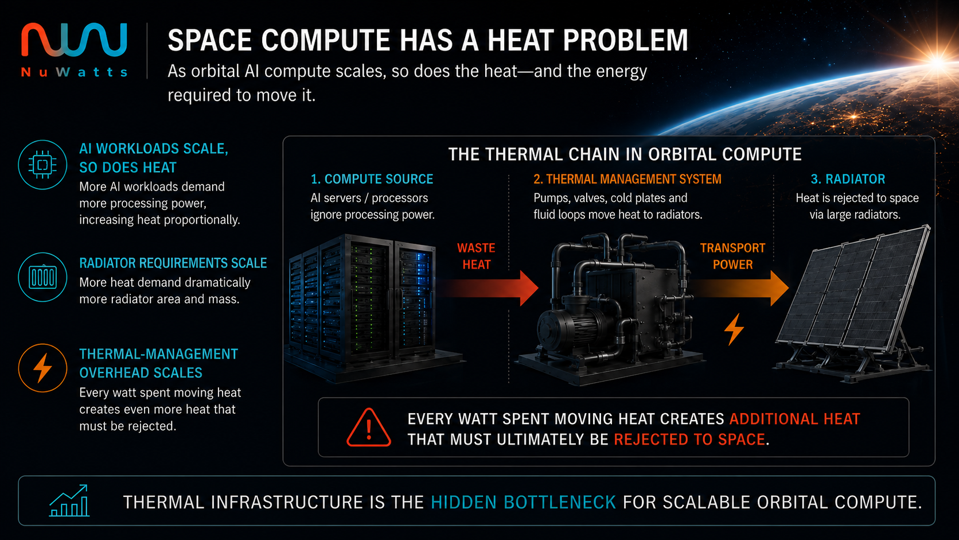
Space Compute Has a Heat Problem
Space is cold, but rejecting heat is difficult. Heat from orbital compute must be transported to radiators and rejected by radiation.
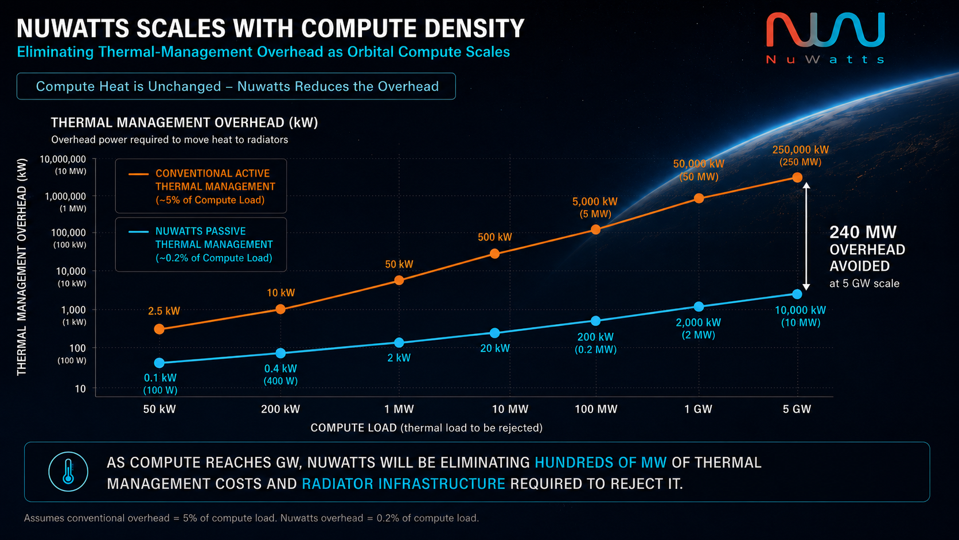
Scale Changes Everything
Small percentages become enormous at orbital data-center scale. A 5% conventional thermal-management overhead becomes 250 MW at 5 GW compute scale.
| Compute Load | Conventional | Nuwatts | Avoided |
|---|---|---|---|
| 50 kW | 2.5 kW | 0.1 kW | 2.4 kW |
| 1 MW | 50 kW | 2 kW | 48 kW |
| 100 MW | 5 MW | 0.2 MW | 4.8 MW |
| 1 GW | 50 MW | 2 MW | 48 MW |
| 5 GW | 250 MW | 10 MW | 240 MW |
Assumptions: conventional active thermal management at 5% of compute load; Nuwatts passive thermal-management overhead at 0.2% of compute load.
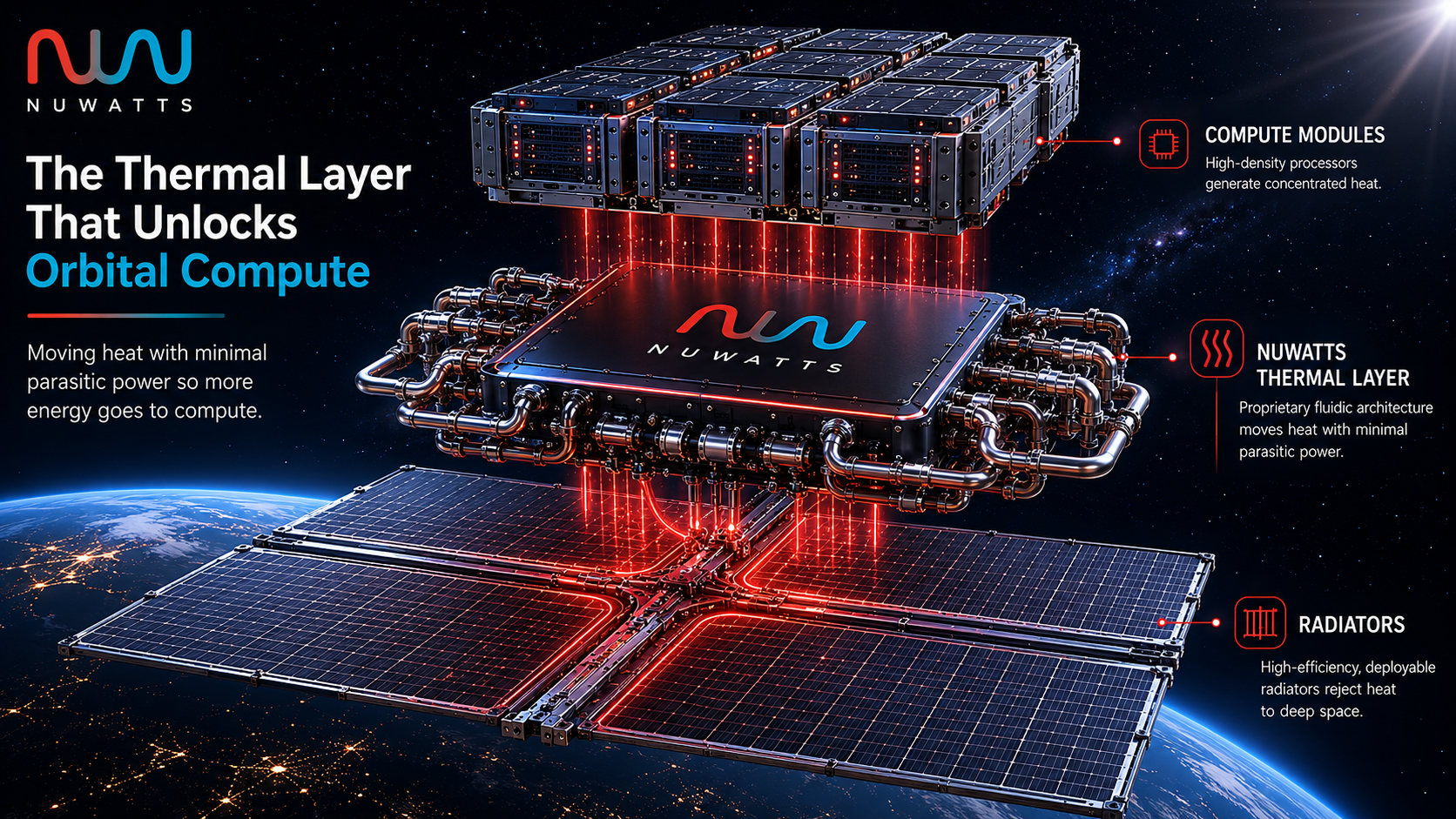
Nuwatts Reduces the Overhead Layer
Nuwatts is building passive thermal infrastructure for orbital compute: move heat with minimal parasitic power, reduce thermal-management overhead, and lower the radiator infrastructure required to reject it.
Reduce Thermal Overhead
Move heat with minimal parasitic power so less supporting energy is converted into additional heat.
Reduce Radiator Burden
Lower thermal-management overhead means less total heat sent to radiators and less radiator infrastructure.
Enable More Compute per kg
By reducing power, mass, and complexity in the thermal loop, orbital platforms can allocate more system capacity to compute.
Why Now
Orbital compute is moving from concept to infrastructure. As systems move from kilowatts to megawatts and beyond, heat transport becomes a defining constraint.
Building the thermal infrastructure layer for orbital compute.
If you are exploring space compute, orbital data centers, advanced thermal architectures, or high-density AI infrastructure, this is the right time to talk.